We build AI that keeps working when the network does not
RAPTOR is a United Kingdom company building edge AI for organisations that cannot send their data to someone else’s infrastructure. The product is a ruggedised unit and the software that runs on it. The position below is what everything else follows from.
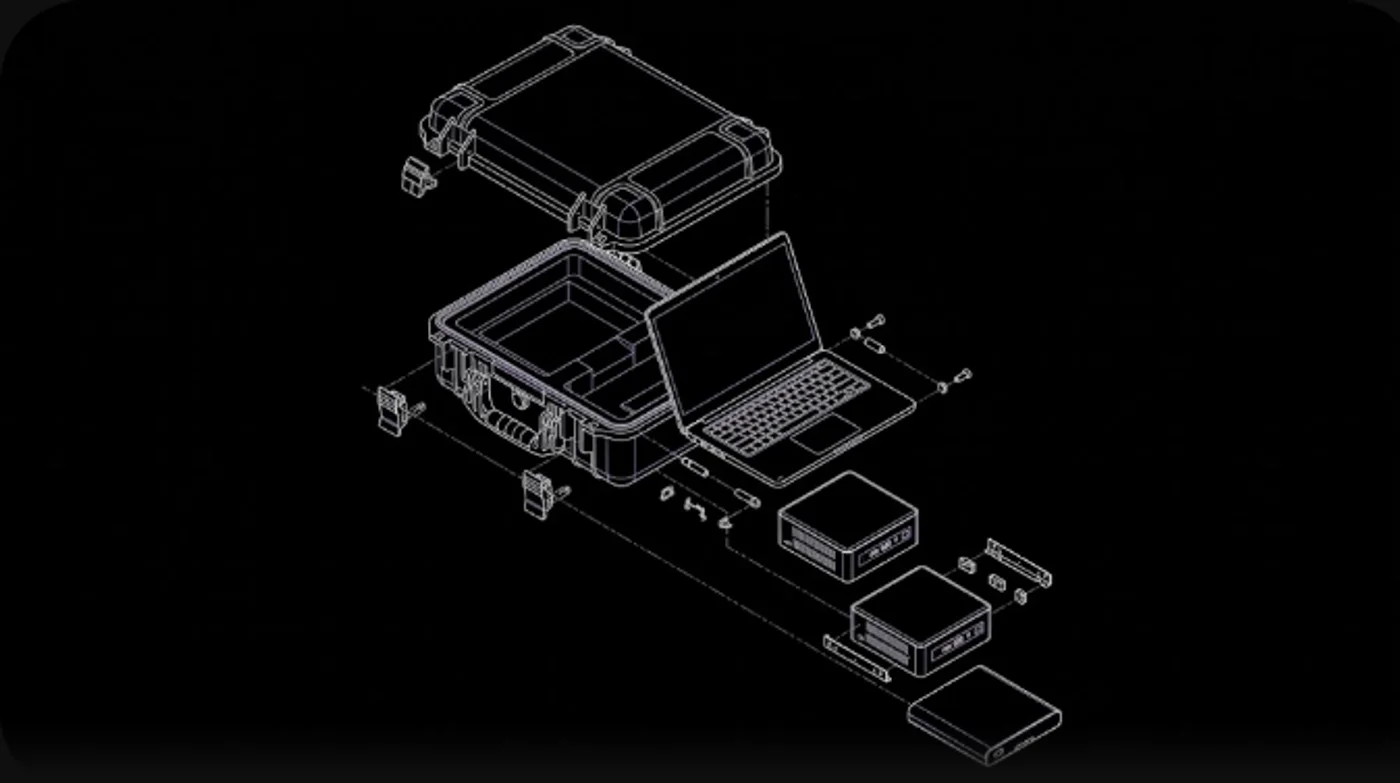
Most AI products are built on an assumption that a network is available and that sending data to a vendor is acceptable. For a great many organisations neither is true, and the answer has usually been to go without. We think that is the wrong trade, and that it is a solvable engineering problem rather than a policy one.
So the platform is built the other way round: every model on the device, the management interface served from the node, nothing fetched at runtime, and nothing reported back. What that costs is convenience for us. What it buys is a system whose behaviour in a sealed facility is identical to its behaviour on a bench.
What we will and will not do
These are commitments about how the product is built, not aspirations. Each one costs us something, which is how you can tell they are real.
- Measured, not promised
- Every capacity figure we quote comes from a benchmark on the hardware, with the method published. During development we have thrown away entire result sets after finding a harness was flattering itself — a cache left warm, a decode failure recorded as a success. A number we cannot defend is worse than no number.
- Open weights, held by you
- The models are open-weight files on your device. You can archive them, inspect them and run them in five years. There is no inference API in the path, and no version of this product where the capability depends on us staying reachable.
- No telemetry, at all
- No analytics, no licence check, no update ping, no crash reports carrying context. This is not a setting to be switched off. It is the absence of the code that would do it.
- No remote kill switch
- A licence for a delivered version is perpetual. A term buys support, updates and new model bundles; letting it lapse stops those arriving and does nothing to a deployed system. A capability somebody else can switch off is not sovereign.
- Provenance you can defend
- The deployed catalogue is restricted to Western-developed open-weight models, and each template declares its model, version and licence, so your legal and security teams can see exactly what they are agreeing to.
- Built for the operator
- The person using this in the field is not a platform engineer. Deploying a capability, proving it works and reading its health all happen on one screen, without a terminal.
How an engagement runs
- 01
Workload first
We start from what you actually need to process — how many people, what kind of material, how long the documents are — because that decides the configuration. It is also the only way to give you capacity figures that mean anything.
- 02
Evaluation on real material
Wherever your security posture allows it, the models are evaluated against your own corpus rather than a public leaderboard. A model that leads a benchmark and fails on your documents is not the right model.
- 03
Delivery, imaged and sealed
The unit arrives with the platform, the catalogue and the model weights already installed and benchmarked. There is no first-run download, and no account to create.
- 04
Updates on your terms
New models and platform versions arrive as verified, versioned bundles, applied on your schedule through your own transfer process. The previous version stays on the unit so a change can be rolled back.
Talk to us
Technical questions get technical answers. If you want the measured figures for a workload, or a conversation about whether this fits your constraints, write to us.
[email protected]Keep reading
The benchmark method behind every capacity figure we quote, published so you can pull it apart.
What an air gap means for an AI stack, and the six things that have to be true for models to run with no network.
Control of data, model weights and infrastructure within your own jurisdiction, and why a local cloud region is not the same.
Ready to deploy?
Talk to the team about configurations, deployment timelines and getting a unit in front of your operators.